Friday, March 13, 2009

Successfully Nude at Mardi Gras

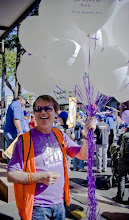
Last weekend saw the 31st annual Lesbian Gay Mardi Gras in Sydney. My friend and colleague, Rollan McCleary, was there and has written a piece about it on his blog. As a bit of background, Rollan is a nude activist and has on a number of occasions with others attempted a nude presence at Mardi Gras. Certainly at comparable events overseas such as at Toronto and San Francisco, nudity has never been a problem and there are often large nude contingents in the Stonewall Day/LGBT Pride/LGBT Freedom day parades overseas. But not in Australia. Australia has some of the industrial world's worst laws on public nudity. Here in Qld, local artist Ken Wenzell fought a two year legal case after being arrested by police for nude sunbathing on a secluded beach at the Sunshine Coast.

Sydney's Mardi Gras might be FABULOUS and OUTRAGEOUS but the organisers have always been quick to stop public nudity in the past. This year Rollan and others planned to march near-naked carrying placards protesting the laws against public nudity. Rollan was wearing a fishnet jock but circumstances worked out that he was able to to remove it during the parade and walk naked for over a kilometre. As someone commented to Rollan at parade's end: “You’re a lucky guy. It all worked out just as you needed - so well anyone would think God himself arranged it all”…. And Rollan, who is Christian, continues on his blog: '“Oh, yes” I said a bit taken aback and unsure how to reply.'

Read all about it, and Rollan's latest publishing venture, in Joan Rivers Wanted to Interview Me.


Wednesday, March 11, 2009

Uri Avnery on the Israeli-Palestinian Peace Process

Uri Avnery is a long term Israeli peace activist, left wing activist, journalist and politician and always worth reading. He has been an advocate of a two state solution since the estalishment of the state of Israel back in 1948 and originally avocated a broad anti-colonialist alliance of Jews and Arabs to liberate the "Semitic Region" (his term for the Middle East) from imperialism and colonialism.

I regularly pick up his articles at the Information Clearing House which is where I saw this piece reflecting ruefully on the current situation in Israel/Palestine. I want to quote some of his observations here.

If you stop any ten random passers-by in a Tel Aviv street and ask them what they think about the chances of peace, nine of them will shrug their shoulders and answer: It won’t happen. No chance. The conflict will just go on forever.
They will not say: We don’t want peace, the price of peace is too high. On the contrary, many will declare that for peace they are ready to give back the occupied territories, even East Jerusalem, and let the Palestinians have a state of their own. Sure. Why not? But, they will add: No chance. There will be no peace.
Some will say: The Arabs don’t want it. Others will say: Our leaders can’t do it. But the conclusion is the same: It just won’t happen.
A similar poll of Palestinians would probably yield the same results: We want peace. Peace would be wonderful. But there’s no chance. It won’t happen.
This mood has produced the same political situation on both sides. In the Palestinian elections, Hamas won, not because of its ideology but because it expresses the despair of peace with Israel. In the Israeli elections, there was a general move to the Right: Leftists voted for Kadima, Kadima people voted for Likud, Likud people voted for the fascist factions.
Without hope there is no Left. The Left is by nature optimistic, it believes in a better future, in the chance of changing everything for the better. The Right is by nature pessimistic. It does not believe in the possibility of changing human nature and society for the better, it is convinced that war is a law of nature.

On the recent international conference on Gaza:


On TV we were shown a uniquely impressive conference, a huge assembly of world leaders, who all came to Sharm-el-Sheikh. Who was not there? Chinese and Japanese rubbed shoulders with Saudis and Qataris. Nicholas Sarkozy was everywhere (Indeed, it was well-nigh impossible to take a photo without the hyper-active French president appearing in it somewhere.) Hillary Clinton was the star. Hosni Mubarak celebrated his achievement in getting them all together on Egyptian soil..

And for what? For little, poor Gaza. It has to be rebuilt. It was a celebration of sanctimonious hypocrisy, in the very best tradition of international diplomacy.

First of all, nobody from Gaza was there. As in the heyday of European imperialism, 150 years ago, the fate of the Natives was decided without the Natives themselves being present. Who needs them? After all, they are Primitives. Better without them.

Not only Hamas was absent. A delegation of Gaza businessmen and civil society activists could not come either. Mubarak just did not allow them to pass the Rafah crossing. The gate of the prison called Gaza was barred by the Egyptian jailers.

The absence of delegates from Gaza, and especially from Hamas, turned the conference into a farce. Hamas rules Gaza. It won the elections there, as in all the Palestinian territories, and continues to govern it even after one of the mightiest armies in the world spent 22 days trying to dislodge it. Nothing will happen in the Gaza Strip without the consent of Hamas. The world-wide decision to rebuild Gaza without the participation of Hamas is sheer foolishness.

And on the current state of play on the peace process in Israeli politics:


This is now a test for all those who stood at the cradle of the “Two State” idea some 60 years ago.
This vision was – and remains – the only viable solution to the Israeli-Palestinian conflict. The sole realistic alternative is the continuation of the present situation – occupation, oppression, Apartheid, war. But the enemies of this vision have smartened up and pretend to support it on every occasion.
Avigdor Liberman is in favor of “Two States”. Absolutely. He spells it out: several Palestinian enclaves, each of them surrounded by the Israeli military and by settlers like himself. These Bantustans will be called “a Palestinian state”. An ideal solution, indeed: the State of Israel will be cleansed of Arabs, but will continue to rule over all of the West Bank and the Gaza Strip.
Binyamin Netanyahu has a similar vision, but differently worded: the Arabs will “govern themselves”. They will govern their towns and villages, but not the territory, neither the West Bank nor the Gaza Strip. They will have no army, of course, and no control of the airspace over their heads, neither will they have any physical contact with neighboring countries. Menachem Begin used to call this “autonomy”.
But there will be “economic peace”. The Palestinian economy will “flourish”. Even Hillary Clinton ridiculed this idea publicly before meeting with Netanyahu.
Tzipi Livni wants “Two Nation-States”. Yes’ Ma’m. When? Well… First of all there have to be negotiations, unlimited in time. They did not come to fruition during the years she has been conducting them, nor have they got anywhere at all. Ehud Olmert speaks about the “Political Process” – why did he not bring it to a successful conclusion during the years of his stewardship? How long must the “Process” go on? Five years? Fifty? Five hundred
So Hillary speaks about “Two States”. Speaks with great vigor. Is ready to speak about it with any Israeli government that will be set up, even if inspired by the ideas of Meir Kahane. The main thing is that they talk with Mahmoud Abbas, and that Abbas in the meantime receives money, a lot of money.
An EXTREME right-wing government is about to be set up.

While I respect Avnery I think the time of the Two State solution has passed, if there ever could be such a time. It was killed when Israel began the settlements in the Palestinian territories. I can't see any way of dislodging those people voluntarily. Many of them are fanatics and deeply immured in a disturbing racism against their Arab neighbours. The only possibility for a Two State solution would be if the settlers accepted citizenship in the new Palestinian state and gave up the perks and privileges they currently enjoy, provided by the Israeli government.

My personal view is that there were two catastrophes for the Jewish people/s in the 20th century. The first was the Nazi Holocaust and the second was the Zionist triumph through the establishment of the state of Israel. The latter was dependent on the former. Mass extermination of the Jews of Europe meant the elimination of both the political and religious opposition to Zionism within the Jewish world. People today don't realise that prior to the Holocaust Zionism was regarded as an anti-religious and even blasphemous and sacrilegious movement by Orthodox and Hasidic Jewry. The great rabbinical schools of Orthodox and Hasidic Judaism were based in the Eastern European heartland and were destroyed by the Nazis. In the post-war period, amongst the Jewish emigres in Palestine primarily there was a reconfiguration of Judaism to re-orient along Zionist lines. This actually marked significant rupture with Rabbinic tradition, a rupture that could only have been successful following the elimination of the great mass of European Jewry and it s religious leadership and the concomitant severe trauma amongst the surviving populations. But the Zionist triumph and the state of Israel represented a catastrophe, ehtical, spiritual, cultural as severe as the Nazi Holocaust. However there are surviviors who remain steadfast to the older form of Orthodox Judaism. You can find links ot them in he list of Some Interesting Sites down the side below.

Just as tragically Zionism has resulted in a similar spiritual and ethical catastrophe in US Protestant Evangelaical and Charismatic Christianity. Riddled with the heresy of dispensationalism, these Christians have become infected with a most nasty form of Christian Zionism, which, as with the Jewish settlers of the West Bank, has corrupted them with a vile form racism against Arab people, as well as providing a basis for a masked but vuirulent form of anti-Semitism entertaining fantasies of a destruction of the Jewish peoples that would make Hitler's attempts look like child's play.

Even if it was morally tenable, the Two State solution is no longer viable thanks to the settlements. The only solution I can see is the creation of a secular, democratic state of Palestine with its capital in Jerusalem with citizenship for all: Jewish, Arab, Armenian, Russian and Greek; Christian, Muslim, Druze, Rabbinic Jew, Karaite, Samaritan, Bahai, Raelian, agnostic, atheist and all.

Update: Two interesting pieces from today's Asia Times. In the first, Robert Dreyfuss, discusses the recent Charles Freeman affair in Washington and asks whether the Israel lobby there have, in fact, overplayed their hand. Their very sucess in thwarting Freeman's appointment shows without a doubt that there is a definite organised Israel lobby that exerts considerable influence on Washington. Furthermore, as he points out, not only does this lobby, for the main consist, of rightwing Zionist neo-conservatives but:

Israel is about to be run by an extremist, ultra right-wing government led by Likud Party leader Bibi Netanyahu, and including the even more extreme party of Avigdor Lieberman, as well as a host of radical-right religious parties. It's an ugly coalition that is guaranteed to clash with the priorities of the Obama White House.

As a result, the arrival of the Netanyahu-Lieberman government is also guaranteed to prove a crisis moment for the Israel lobby. It will present an enormous public-relations problem, akin to the one that faced advertising agency Hill & Knowlton during the decades in which it had to defend Philip Morris, the hated cigarette company that repeatedly denied the link between its products and cancer. The Israel lobby knows that it will be difficult to sell cartons of menthol smooth Netanyahu-Lieberman 100s to American consumers.
In the other piece, Ramzy Baroud, reflects on the prospects of a third Palestinian Intifada. A number of issues are simmering that could provoke it but:
some of the most contentious issues throughout the years have been the crimes of house demolitions, settlement construction in the Occupied Territories and the increasing number of settlers moving into those ever-growing settlements.

In a recent interview with Ma'an news agency, the Palestinian Authority's governor to Jerusalem warned that the planned demolition of 100 Palestinian homes and the displacement of nearly 1,000 people in the occupied Jerusalem area would certainly increase the growing possibility of a third Intifada. "It is now clear to the international community, and our position within the Palestinian Authority is very clear - no negotiations, no peace process with settlements," he stressed.

Baroud continues:
There is a great fear that the Israeli plan, which some have described as "slow-motion ethnic cleansing", is now augmenting into a fast-paced settlement project. These worries have been confirmed by the Israeli "Peace Now" movement, in a press release, issued on March 2.

"The Ministry of Construction and Housing is planning to construct at least 73,300 housing units in the West Bank," Peace Now reported. It further stated that the plans outlined in the Israeli Ministry of Housing report "represent only a small part of the total number of the plans existing in the settlements".

"At least 15,000 housing units have already been approved and plans for an additional 58,000 housing units are yet to be approved," said the group, which also concluded that of the units already approved by the Israeli government, nearly 9,000 have been built. "If all the plans are realized, the number of settlers in the territories will be doubled."

He further observes:
The new illegal units are built on stolen land, illegally confiscated from their rightful Palestinian owners. With such a move, Israel purposely renders the so-called two-state solution permanently incapacitated, while insisting that a one-state solution is the equivalent to the "annihilation" of the Jewish state.

Sunday, March 8, 2009

Vale Marcella Althaus-Reid 1952-2009

I heard recently of the death of queer theologian, Marcella Althaus-Reid, last month in Scotland where she held the chair of Contextual Theology at the School of Divinity, University of Edinburgh. Marcella was from Argentina of Protestant background and studied at ISEDET Protestant Theological Faculty in Buenos Aires. She completed her PhD at University of St Andrews in Scotland.

I confess that I have read little of her work probably because she did not deal very much with biblical matters but was primarily a theologian. So much of theology engages little with biblical texts, that nowadays I find that, without the biblical anchor, I can't really connect with it. The book I must read is Indecent Theology, in which she engages with liberation theology, feminist theology and queer theology in South American context. There is a very good summary of her thesis here from which I want to quote the following

Its starting point is a suspicion on the ideological use of traditional understandings of the category of Decencia/Indecencia (Decency/Indecency) in the Latin American cultures, and specifically in Argentina.

Decencia is a concept that traditionally has implications of honesty and truthworthiness for men (especially in economic transactions) but for women, it is a different story. Decencia for women in this context implies a complex set of regulations of sexuality (as in sexual options), the dealings with transgressions of expected behaviour according to age and civil state, but also a complex web of expectations based on gender perceptions and sexual understandings including codes of dress, mobility and hairstyle. It gets further complicated with economic issues but also with race. Somehow poor women are more prone to be considered indecent than wealthy ones. If they are indigenous or black women, this adds an extra category of indecency , that is, of oppression.

Decency and Indecency are therefore gender/sexual/ racial/economical categories of defining 'normality' in people's lives and in society. What is expected and proper. But what is expected and considered proper for Latin American women to be 'decent' masks a multitude of oppressions.


This gendered hierarchy of decency is not peculiar to South America but dates back into the ancient Mediterranean world and has analogues in all the great ancient civilisations. Wombs were places of power and consequently had to be controlled and indeed male power was very much invested in control of the wombs of women. Ever since the rise of agriculture, wombs were considered as fields in which men sowed their seed and like fields had to be fenced in and access controlled so as to ensure ownership of the products of said womb (field). Endogamous or close-kin marraige was common throughout the Mediterranean world to ensure that wombs were kept within the orbit of the clan. With urban civilisation came the opportunity for greater hierarchialisation and the development of class so those at the top of the social pyramid, if male, had greater sexual access to those below in the hierarchy. Slaves were at the bottom and household slaves were considered available sexually to the male householder, both male and female and regardless of age. They were household property after all.

These patterns of class and gender/sexuality are reflected in ancient literature including the biblical texts. Given that male male anal sex in the ancient world was understood as a form of subordination of one male by another, I wonder if the Levitical taboos on male male anal sex (Lev 18:22, 20:13) even if borrowed from Persian religion, were not an attempt at building a male solidarity as part of the Holiness Code for priests and Levites. I also wonder if Paul's arsenokoites (1 Corinthians 6:9 and 1 Timothy 1:20) generally translated as sodomite, homosexual, sexual pervert etc in English bibles might not actually refer to such phallic aggressive males, especially such householders who screwed anything that moved by right and without consideration for consent or other such niceties (ancient Christianity was a religion of slaves, amongst others, after all).

But I have wandered far from Marcella Althaus-Reid. I'll conclude with a quite from Bob Shore-Goss obituary for her from a recent Other Sheep e-newsletter:

Marcella was very familiar with my own theological work, so she had her editor at Routledge send me her manuscript of her book Indecent Theology for an endorsement quotation. I read the manuscript with a perverse glee, noting how I originally underrated this creatively, queer and in her own words, “indecent Latina, bisexual theologian.” Marcella maintains that all theology is sexual theology, and she explored how vanilla Christian sexual theologies were oppressive. As an outsider, she creates an indecent theology, a counter-patriarchal and heterosexist theology.

And so I wrote an audacious endorsement quote for the back cover of the book: “I believe that this may be the best feminist theology (and I am not exaggerating) in the last decade.” And I meant the quote, for Marcella adeptly brought class and economic analysis to feminist theology, from a postcolonial perspective, into her indecent, albeit queer theology.

It was a pioneer development in feminist and queer theologies.

Kwo Pui Lan, a professor at the Episcopal Divinity School, contacted me in the spring of 2001 to participate on a panel to review Indecent Theology at the American Academy of Religion. Pui Lan mentioned that the invitation originated from tMarcella’s suggestion.

I was the only male panelist on the panel of the Feminist Theology Group, and my paper, “Expanding Christ’s Wardrobe of Dresses,” became one of the essays on Christology in Queering Christ. The essay built on her insight into the nomadic and bisexual incarnation of Christ.At the AmericanAcademy of Religion in November 2001, I had the opportunity to interact with this feisty and bold Argentinean theologian, stylishly dressed in a black skirt and blouse with polished leather boots.There was no mistaken that I met a theologian embedded in the leather/fetish community as well.There was strong scholarly kinship already, and our friendship instantaneous.

Marcella tried hard to get the manuscript Gay Catholic Priests and Clerical Sexual Misconduct published in the UK, but publishers were too timid about the content. It was about the same time when I was teaching in Thailand, that I received news that the dean of Webster was opposing the Religious Studies Department’s recommendation for my tenure evaluation. I was turned down for tenure, for more than transparent reasons. Marcella Althaus-Reid organized a group of theologians in the United Kingdom to write the President of Webster University. She wrote to the President asking him to overturn what she considered a violation of academic freedom but also a human rights violation to silence my voice.Later she commented to me that the President of Webster University did not her the courtesy by not even acknowledging receipt of her letter. In 2003, Marcella published The Queer God, a very seminal book in queer theology.I read the book, and I sent her an email of congratulations, explaining that while I may have previously wore the mantle of outrageous queer theology, she had superseded me, and I gladly acceded that mantle to her until we could write a collaborative, transgressive, and indecent theology. On her website, she writes, “The Queer God is a call to 'disaffiliation' processes in theology. To be unfaithful to sexual ideological constructions of God in order to liberate God- a Queer God who also needs to come out of the closet of theologians of the status quo.” She wrote about God “found in the complexity of unruly sexualities and relationships,” or she as coined the phrase—“god of the dark allies.”.

Eternal life grant unto her, Most High, and may perpetual light shine upon her. May she always shine in the perpetual light of your presence.


UPDATE: More information in English and Spanish plus further discussion at Holy Vignettes here.

Some More on St Mary's. Diptychs: A Missed Opportunity

My series on St Mary's seems to have generated a bit of interest, presumably because of the apparent novelty of a gay man like me who leans towards the "left" of the Church critiquing a congregation that not only situate themselves on the "progressive" side but aim at being inclusive of LGBT people. How shocking!

But because of this interest I keep getting bits of feedback and commentary both electronically and in daily life. So I've heard that, yes, all the publicity caused by the affair has definitely led to people, who would not normally do so, turning up at St Mary's on the assumption that it might be a church for them. I was told that a number of lesbian families have started attending there now. I don't know whether these women were Catholic or not before the affair erupted into the news. I have also heard some strange stories as to why the priests there wont do a lot of things in terms of vesting, the communion cup, Peter Kennedy's bottled water business that he operates through the church and so forth. The one common pattern in all these stories is the way so many decisions about practice seem to be based on the personal likes and dislikes of the priests, Peter and Terry, and not anything substantive even stemming from some form of 'progressive' theological position.

One story concerns why Terry won't wear the alb or anything else too clerical. The story is a little garbled both from my memory and the recounting. But it appears that Terry got some negative feedback at one time from some kids in the church saying how he reminded them of a rather bossy priest who was always telling them what to do. Terry stopped wearing the alb at all on that basis.

A more serious story I've been told concerns why the anaphora or eucharistic prayer was so seriously denatured in St Mary's. According to my informant, who's been attending St Mary's for some time on an occasional basis, the reason for altering, changing and then writing their own eucharistic prayers was the wish not to pray for the Pope at every Mass. This prayer in question comes after the consecration and thanksgiving/offering and, generally, in the Roman rite within the Roman communion, prays for the local bishop/archbishop, Pope, all the clergy and people. If what I have been told is true then it would appear that Archbishop Bathersby's concerns raised in his letter last August that St Mary's had withdrawn itself from communion with the Roman church have some basis to an extent that even the Archbishop himself didn't appreciate.

This prayer that the two priests wanted to elide is a form of what's known in the eastern churches as the diptychs. This prayer highlights the connectedness of the local congregation with the broader church. It's found in pretty much all the rites of Catholic Christianity east and west and always forms part of the greater eucharistic prayer. In the days before the great schisms of east and west in the first millenium, the days of the Catholic Ecumenical church of the five patriarchs (Rome, Constantinople, Antioch, Jerusalem and Alexandria) it was the norm for the five patriarchs to pray for each other in the diptychs. For any of the patriarchs to omit mention of the others in the diptychs at the eucharist was a serious matter - it signified a rupture of communion. In the struggles between Alexandria and Constantinople for primacy, omitting one's rival/fellow primate in the diptychs was one tactic deployed on both sides to signify rupture and likewise in the latter first millennium in the struggles between Rome and Constantinople. Much more than formal excommunication, omission from the diptychs was the way one patriarchal see signalled a break with another.

I don't know how familiar the priests at St Mary's are with church and liturgical history (a lot of the time I think not much) but if it is true that they wanted to omit mention of the Pope in the eucharist then they have effectively severed communion with the Roman church and, indeed the Brisbane church of the Roman communion too (especially as they also omitted their Archbishop to boot). I don't think most Catholics (Roman or otherwise) really appeciate or understand the purpose of the diptychs in the eucharist. Consequently I don't think most of the St Mary's congregation appreciate just what has been done by these changes that along with so much else, seem to have been instigated by the priests.

This is possibly one of the saddest instances of St Mary's reformulated liturgy because there was a for more expansive and, indeed, most Catholic possiblity that St Mary's could have embraced instead. Instead of dropping the prayer altogether, it would have been better to expand it by remembering at least the other four Patriarchies of the older Ecumenical church. i.e Constantinople, Antioch, Jerusalem and Alexandria and possibly some other primatial sees as well e.g Moscow, Echmiadzin, Utrecht, Canterbury, Uppsala, and, for some more gendered nuance, the presiding bishop of the US Episcopalian church, and, for a local touch, the Primate of the Anglican Church in Australia. In this way St Mary's could be a pioneer on the road to full intercommunion across all the jurisdictions of the broader Catholic Church.

Such intercommunion won't occur until people get into the habit of praying for each other in the diptychs. It's likely the rupture between east and west was easier once both sides had omittted each other from their diptychs. Inclusion in the diptychs rather than dropping them altogether could have signalled catholicity and commitment to restoring the connections that have lapsed. In so doing it would be fulfilling one purpose of the eucharist, which is to create connection, community, communion. But instead, dumping the diptychs not only effectively severed St Mary's from a broader connection even with the Roman communion but also led to St Mary's effectively dumping the eucharist itself.

As I said I've been hearing all sorts of stories about St Mary's and the background to some of the odd things that it does. If you have a story to tell, let me know.

I still plan to write on the media and St Marys when time allows. There's been more in the papers today. But if you went a giggle check out this piece in the Spectator by the Dreadnought, John Heard. I'm not quite certain what his point is but it seems to be that the clampdown on St Mary's by Archbishop Bathesby represents some sort of resurgence of the Tridentine rite against 'liberal' liturgies. But I'm open to other suggestions. Heard is an oddly tragic figure but one who is so immured within his own contradictions and clearly without any self analysis and reflection that he can't see his own tragedy but sails on blithely regardless.

Wednesday, March 4, 2009

The Book of Odes - a forgotten biblical text

I want to take a break from the St Mary's issues tonight and return to a bit of biblioblogging. This will be my first biblical piece for March. I thought I'd write about one of the forgotten biblical texts that no longer appears in any Christian bibles. I'm talking about the Book of Odes. What you may ask is the Book of Odes? Quite frankly it's a text found in one of the ancient Christian bibles, the Codex Alexandrinus, the oldest most complete codex of the Greek bible. The Odes are appended to the Psalms. The Odes also appear in the Psalms codex, Codex Turicensis, where again they are appended to the Psalms. So what are these Odes?

Basically they are a collection of prayers and canticles from the Old and New Testaments. The Rahlfs Septuaginta orders them as follows:

1. First Ode of Moses (Exodus 15:1-19)
2. Second Ode of Moses (Deuteronomy 32:1-43)
3. Prayer of Anna the Mother of Samuel (1 Samuel 2:1-10)
4. Prayer of Habbakuk (Habbakuk 3:2-19)
5. Prayer of Isaias (Isaiah 26:9-20)
6. Prayer of Jonah (Jonah 2:3-10)
7. Prayer of Azariah (Daniel 3:26-45, a deuterocanonical portion)
8. Song of the Three Young Men (Daniel 3:52-88, a deuterocanonical portion)
9. The Magnificat; Prayer of Mary the Theotokos (Luke 1:46-55) and Canticle of Zachariah (Luke 1:68-79)
10. Canticle of Isaiah (Isaiah 5:1-9)
11. Prayer of Hezekiah (Isaiah 38:10-20)
12. Prayer of Manasseh, King of Judah when he was held captive in Babylon (ref. in 2 Chronicles 33:11-13 and appears also as a separate deuterocanonical book)
13. Nunc dimittis; Prayer of Simeon (Luke 2:29-32)
14. Gloria in Excelsis Deo; Canticle of the Early Morning (some lines from Luke 2:14, Psalm 144:2 and Psalm 118:12)

I have not yet found any real studies on this quite intersting little text. Clearly as it is mostly texts from the Old and New Testaments any scholars that do know of it are likely more interested in those component texts in their other contexts.

This book interests me for two reasons. First, it was probably the vehicle that delivered the Prayer of Manasseh into scripture. Secondly I think it testifies to the close links between liturgy and scripture. Odes clearly has some liturgical role either in the Mass or in the liturgical rounds of daily prayer. Ode 14, incorporating as it does the Canticle of the Early Morning indicates that could most likely be its purpose.

So finally, lets bring back this little Book of Odes and return it to our Bibles so that it nestles snuggly once more behind the Psalms


Tuesday, March 3, 2009

St Mary's 3

I had hoped by now to write on the media and St Mary's but I wanted to address another issue about what's been happening there, what I would term syncretism as neo-colonialism. For some time now St Mary's has had a regular Buddhist meditation group. I only found out about it last year.

Of course the obvious question arises why Buddhist meditation at a Christian church? It's not as if there aren't Christian traditions of meditation. Indeed there is a world wide movement for Christian meditation which comes out of the work of a Benedictine monk, John Main, and under the currrent drection of his student the Benedictine, Laurence Freeman. They have many groups in Brisbane including one at St Francis church in West End but nothing listed at St Mary's. Furthermore there are rich meditation traditions in both eastern and western Christianity, including the Jesus Prayer of Eastern Orthodoxy. So I am curious as to why a Buddhist meditation group.

I'm not criticising Buddhist meditation. Of all religions, Buddhism is the most adaptable and can sit together with just about any other religion. I further appreciate how mutually enriching inter-faith dialogue of Christian, Buddhist, Hindu monastics has been. Long may it flourish! But I also know that there are varieties of Buddhism and of meditation practices. One of my friends and colleagues while doing my PhD was Patrick a practitioner and teacher of Vipassana or insight meditation. So I wonder what sort of Buddhist meditation is being taught at St Mary's?

Very recently I found out that it is the unofficial priest, Terry Fitzpatrick, who runs this group and presumably is the meditation teacher. Now I have a number of friends who are Buddhist practitioners. some of whom have entered the sangha. I think I have a grasp of what is going on in Buddhist meditation. Patrick especially taught me much about vipassana and I think I can understand its dynamics. Patrick learnt much of it in monasteries in southeast Asia. So I also know that there's a lot of work involved before someone can teach this stuff. I might have a grasp of what's going on but I would never set out to teach it although I could teach people about it which is a different thing altogether.

So what's happening at St Mary's. Is it a case of trendy neo-colonial appropriation as was the case with the supposed 'native american dance for peace' we were invited to join at the opening of the Good Friday liturgy back in 2003? If there were Native Americans in the congregation at the time I would have but St Mary's is one of the whitest congregations I've been in in Brisbane. So my friend and I walked out and went to the cathedral because that was clearly a case of Native American = 'spiritual' = cool, lets appropriate it. I wonder if the Buddhist meditation is more of the same. And I wonder what credentials, if any, Terry has to teach it or whether this is just another case of appropriating neo-colonial spiritual cool.

I discover a new saint - St Maria Skobtsova of Paris and Ravensbruck and her companions

In writing my pieces here I generally will search out relevant internet material. While writing my last two pieces on St Mary's I stumbled across an interesting Orthodox site, In Communion, which I'm going to add to my links here. While checking out the site I discovered a new saint, Maria Skobtsova of Paris and Ravensbruck, several actually because she has some companions, including her son, all of whom were martyrs under the Nazis.

Everything about this woman is remarkable, a poet, a member of the Social Revolutionary Party, she was elected mayor of her town in 1918. Twice married, the second time to the White Army judge who released her rather than sentence her to death as a Red. They fled Bolshevik Russia with her mother and child from her first marriage. Eventually they settled in Paris. She hads a son and daughter to her second husband. The death of the daughter led ot the break up of the marriage. Eventually Maria took vows as a nun but resolved not to live in a clositered convent but to be out and active in the world. In the early 30s she established a house of hospitality in Paris. It appears she mostly worked amongst the Russina emigre population. I rather love this snapshot of her in those days

She was a very unusual nun in her behavior and her manners. I was simply staggered when I saw her for the first time in monastic clothes. I was walking along the Boulevard Montparnasse and I saw: in front of a café, on the pavement, there was a table, on the table was a glass of beer and behind the glass was sitting a Russian nun in full monastic robes. I looked at her and decided that I would never go near that woman. I was young then and held extreme views.

And another

She went to the steel foundry in Creusot, where a large number of Russian [refugees] were working. She came there and announced that she was preparing to give a series of lectures on Dostoevsky. She was met with general howling: “We do not need Dostoevsky. We need linen ironed, we need our rooms cleaned, we need our clothes mended — and you bring us Dostoevsky!” And she answered: “Fine, if that is needed, let us leave Dostoevsky alone.” And for several days she cleaned rooms, sewed, mended, ironed, cleaned. When she had finished doing all that, they asked her to talk about Dostoevsky. This made a big impression on me, because she did not say: “I did not come here to iron for you or clean your rooms. Can you not do that yourselves?” She responded immediately and in this way she won the hearts and minds of the people.

It's amazing to reflect that at the same time as St Maria is active in Paris, Dorothy Day is likewise active in the Catholic Worker movement with its houses of hospitality in the US and Catherine de Hueck had opened Madonna House in Toronto. Catherine was also from Russia. The 1930s was an amazing time spiritually.

Maria Skobtsova's credo was: “Each person is the very icon of God incarnate in the world.” With this recognition came the need “to accept this awesome revelation of God unconditionally, to venerate the image of God” in her brothers and sisters.

It was this that led to her martyrdom by the Nazis, together with her son and other companions. Maria gave assistance to Jews, sheltering them in her house of hospitality, helping them to escape Paris and through her priest, St Dimitri Klepinin, providing Jews with baptismal certificates to help avoid Nazi repressions. Eventually they were arrested together with her son, St Yuri Skobtsova and another friend and collaborator Ilya Fondaminsky. All were eventually deported to Nazi concentration camps were they would perish, Maria at Ravensbruck and the men at Buchenwald.

On January 18, 2004, the Holy Synod of the Ecumenical Patriarchate in Istanbul recognized Mother Maria Skobtsova as a saint along with her son Yuri, the priest who worked closely with her, Fr. Dimitri Klépinin, and her close friend and collaborator Ilya Fondaminsky. Their feast day is July 20.

You can read all about St Maria and her companions here and this page has some wonderful icons plus liturgical material for their commemoration.

Monday, March 2, 2009

St Mary's 2

Actually, it was a good thing that I walked away from St Mary's. It enabled me to re-explore Catholicism and its varieties in my own town. As I mentioned in my previous post, I discovered that the cup was now a standard part of communion in Roman churches, something I would not have known had I remained cocooned at St Mary's. I noticed that most of Roman churches were doing what they could to give women a place in the liturgy. I noticed that in the Cathedral there was a peculiar shuffle on the communion queues as traditionalist Catholics swapped lines so as to be on one where they could take the communion host from the priest and not from a layperson - especially if they were a woman (mind you these traditionalists didn't seem to have the same scruples re receiving the cup from a lay man or woman). Women generally have a much more prominent role compared to the past. In fact in many parishes women, especially nuns, seem to have the main leadership roles due to the shortage of priests.

But most importantly I also explored non-Roman churches too. The Anglican church here in Brisbane is very liturgical, very Catholic, plus it has the advantage of women priests. I like much of the Anglican liturgy and I noticed too that at most Anglican Sunday eucharists I went to there were a lot of people around the altar, not necessarily priests. It seems that almost anyone and everyone who does anything in the liturgy wears vestments of some kind which interstingly did more to decentre the role of the priest than anything at St Mary's. It was brought home to me even more at Christmas time when I found local Anglican and Roman churches close by to where I lived with the Anglicans doing midnight mass at 11pm to finish at midnight while Romans started theirs at midnight. So I'd do both and was struck by the way in the Roman one the priest stood out as the only one vested person whereas the Anglicans had a plethora of vested people around the altar.

An atheist friend of mine who liked checking out different churches took me along to the local Liberal Catholic church. There too everyone around the altar was vested regardless of whether they were priests. The liturgy itself is very beautiful. One thing for sure, Bishop Charles Leadbetter might have been a theosophist but he understood liturgy and the eucharist. He drew on eastern liturgical traditions to revise the Roman rite in quite a remarkable way. I was particularly struck by the fact that every mass in the Liberal Catholic church includes full sacramental absolution at the start of the mass. I realised later that something similar is found in the Anglican liturgy but not at the start but after the liturgy of the word

I also discovered that there was an independent Catholic denomination in Brisbane based at the Community of the Way in Redcliffe and under a bishop based in Sydney. This denomination not only ordained women but was also inclusive of LGBT people. I had known about Independent Catholicism from the internet but it had been mostly an overseas phenomenon. The movement is fissiparous and so now the Redcliffe community is a separate denomination with its own bishop who leads a network of several communities in Australia. One of the priests I knew through the Redcliffe community has himself been consecrated a bishop in another denomination based in the US, the Reformed Catholic Church. He lives in Brisbane and is easier to get to than the community at Redcliffe. So I often celebrate mass with him.

Consequently I call myself a fringe Catholic. I don't restrict myself to the Roman communion. I couldn't, given the official positions on women and homosexuality. But I wont separate myself either. I was born and raised in the Roman church and I wont leave it to make a bunch of homophobes happy. I also believe it is essential for there to be intercommunion between the churches of Catholic Christianity. We all share in the one eucharist and the current pontiff when he was still Cardinal Ratzinger is on the record saying that wherever a valid eucharist is celebrated there is the one holy catholic and apostolic church so in a sense all these churches are united through the eucharist. Intercommunion recognises that fact and I think will do more to establish an eventual unity than all the theological discussions of a year of jubilees.

I say all this because I think that my experiences across the Catholic spectrum (and I have also made the occasional visit to Orthodox churches during this time) has helped to even more contextualise St Mary's and to provide scenarios for ways of being Catholic that are both inclusive/progressive and remain grounded in Catholic tradition. Indeed, I have come to the conclusion that the problem with many of the movements of Catholic reform is that they have taken as their model the Reformation itself. It's almost as if these movements acted on the principle that the Roman church must somehow catch up with the churches of the Reformation. I, on the other hand, think that the Reformation gave the wrong answers to the right questions on both sides of the divide, Catholic and Protestant (there was a Catholic Reformation as much as there was a Protestant one back then). So I'm not interested in turning the Roman church into a version of the Uniting church or a form of low church Jensenite Anglican evangelicalism. Nothing wrong with them, but they aren't Catholic and I don't subscribe to a form of bland syncretism that elides all differences in a merged blancmange. I respect and celebrate such differences and don't hold to the notion that they be done away with in what is always a form of imperialist takeover of one by the other.

So what could St Mary's have done? Well, lets be clear for a start - much of what's been cited in the media as innovative or shocking at St Mary's is not really so. Having Mass in the round is not an issue - many modern churches have been built putting the altar in the middle anyway. Getting rid of most of the pews is no big deal either. Most Orthodox churches don't have pews - people normally stand during the liturgy. Furthermore, none of the liturgical changes they've introduced naturally rely on any social justice theology. (and St Mary's does not have the Brisbane franchise on social justice either). Yes, they go out of their way to give women a key role in the liturgy. But so do most other Roman churches I've been to. Indeed given the shortage of priests locking women out of any sort of role is basically suicidal. St Mary's however does seem to go out of its way to cover up the scandal that women are currently denied ordination in the Roman church. While that may be laudable I think that really serves as a sugar coating to mask the bitter pill. It is a scandal and I don't think it should be mitigated. Covering up the scandal might actually work more to suppress the push for change. And, as I've said before covering up the scandal only serves to reinscribe the role of the priest more strongly. Instead, embrace the scandal and work to expose it so that it eventually will be removed. Here I think the Anglicans have set a good example by vesting everyone who does anything in the liturgy. At St Mary's the priests like to wear their stoles when they do their role. Why not have each person who does a reading or distribute communion or takes on the MC role at the start wear a stole. That way priesthood comes to be seen as a shared quality expressed in different roles. That could be made even more prominent by vesting each person at the start of their bit in the liturgy.

Again at St Mary's they have developed the practice where everyone says the eucharistic prayer along with the priest. My problem here is that it reinscribes the role of the priest while attempting to mask it. Interstingly, I understand the the current pontiff felt that Vatican 2 did not go far enough in promoting he laity as participants in the central core part of the Mass, the eucharistic prayer and that he wanted the priest's role made more interactive. Indeed, many eastern liturgies have a far more interactive eucharistic prayer than western and especially Roman ones. Laity/choir, priests, deacons all have their lines in the interactive drama of the eucharist. I remember many years ago suggesting to Peter Kennedy that it might be useful to check out eastern liturgies for models that could be explored in St Mary's. He didn't seem interested, perhaps because eastern churches weren't considered reformed? But by developing a more interactive eucharistic prayer not only would they have inscribed the role of the laity as having a celebratory role together with the priest but they would even be anticipating and providing a model for what il papa Benedict himself would like to see happen. And in terms of liturgical exploration why not draw on the variety of western rites such as the Ambrosian, Sarum, Gallican, Iberian and even Anglican/Anglo-Catholic, Lutheran/Evangelical Catholic and Liberal and Old Catholic, and even aspects of the Old Tridentine rite (I still like the last gospel John 1 as a way of rounding off the mass)? That way the comunity comes to develop a sense of the richness of its own traditions.

If St Mary's wanted to be even more radical then there are a couple more things I could suggest. Of course with these they put themselves at risk of putting themselves outside the Roman church because then the authority structures are challenged. Why not revive the minor orders? In Roman theology these aren't ordained roles but instead a person is 'installed'. Several minor orders are especially relevant - lector, acolyte, porter (or welcomer) and, from eastern tradition, possibly cantor. The people who perform these roles regularly could be ceremonially installed by the community that way highlighting once more the diversity of liturgical roles and again setting the priest's role in a broader context once more grounded in Catholic tradition.

If St Mary's wanted to be even more radical it could follow the Liberal and Independent Catholic practice of starting each mass with sacramental absolution. I personally think that's where it should be anyway - private confession is something that developed out of the monasteries and while can be important to have a confessor/spiritual guide it should not be a requirement for accessing absolution. This would put St Mary's in conflict with Roman authority which suppressed the general use of the 3rd rite of reconciliation for communal absolution back in the 90s. Like everyone else St Mary's toed the line to stay under the radar rather than push the envelope.

If you are going to be in conflict with Rome why not go the whole hog and actually start ordaining women. Not many people know this but a person can ordain up to their own level, which is why baptism does not require an ordained priest or deacon to adminster it. Indeed in the former Czechoslovakia, during the severe persecution in the communist period, the Catholic church took several extraordinary measures including authorising the ordination of priests by other priests. It was in this time too that the first women were ordained as priests in the Roman church, perhaps since the first millennium. So arguably the priests at St Mary's could ordain women to the priesthood. If they were uncertain about that they could certainly ordain them as deacons spearheading the restoration of the female diaconate in the Roman church ( the female diaconate is being restored officially in the Eastern Orthodox churches and has always continued, albeit in very diminished form, in the Oriental Orthodox churches). Of course, acting in this way would bring Roman authority down on them like a ton of bricks and the St Mary's community would have no option but to leave the Roman church. But at least they would have been both faithful to tradition and pushing the boundaries, challenging the entrenched power structures in a meaningful way. That would have been better than what has happened now where they kept below the radar so as to stay within the Roman church and its privileges while at the same time dissolving everything demonstrably Catholic such affiliation required. And when I talk about St Mary's here I refer to the priests and those who worked with them to actively bring about the currrent situation. As I said in my previoius post I think the majority of pepple at St Marys have been ill served, if not misled by those in charge there.


St Mary's 1

For the last few months people in Brisbane have been bemused, outraged, amused by the fracas at St Marys, the Catholic Parish of South Brisbane. St Mary's is an inner city parish, which over the last 20 years has etablished a reputation for being experimental, of pushing the envelope, of working out new ways of being Catholic and of being inclusive and welcoming for people who were alienated from the officla Roman church. St Mary's also provides the base where a range of social justice projects known as Project Micah operate from. Consequently St Mary's has become known as a social justice church, a place where spirituality and worship are informed by a commitment to social justice and social justice is grounded in the spiritual life of the community. St Mary's maverick reputation has meant it has been subject of regular complaints by conservatives, known as the Temple police, who for many years now have made of point of spying on Catholic parishes and reporting any breaches of conservative orthodoxy to Rome. Their biggest sucess was in getting the use of the 3rd rite of reconciliation effectively outlawed from use in Catholic churches in this country during the 90s. Before then it was commonly used at both Christmas and Easter. Last August, the Catholic Archbishop of Brisbane, John Bathersby, wrote this letter to Peter Kennedy, the parish priest/administrator at St Mary's. Bathersby raisd concerns on several issues to do with faith, liturgy, governance and authority. A to-ing and fro-ing of communication culminated in the sacking of Peter Kennedy last month. The Catholic Dean of Brisbane, Ken Howell, was appointed to minister to St Mary's. However Peter Kennedy and the community would not accept the decision and the Archbishop has still not been able to enforce his decision. Peter Kennedy and his colleague, Terry Fitzpatrick, a priest not appointed or employed by the Archdiocese and whose status at St Mary's was one of the key issues raised in Bathersby's letter last August, remain at St Mary's pending the outcome of mediation.

The St Mary's story is quite a saga and one that raises several issues. These include authority and autonomy in the Roman church, inclusion/exclusion, questions of the boundaries by which community, identity and continuity are determined, the relationship of reconstruction/adaptation and tradition, as well as the questions of journalistic coverage, the understanding or, more pertinently, the failure of comprehension of he issues on the part of journalists in reporting on this saga. It's further complicated for me in that I used to attend St Mary's fairly regularly but by 2002 had effectively walked away from it as I believed that it had stopped performing any kind of eucharist that I could recognise as such. I found myself walking out of the 2003 Good Friday liturgy (which is not a eucharist) together with a friend of mine because of the appropriation of supposed rituals from a non-Australian indigenous culture, which we understood as yet another trendy new age indulgence in noble savage neo-colonialism. I have been to St Mary's twice since for a Sunday service and nothing I witnessed changed my position that at St Mary's the eucharist has been pretty much abandoned. Instead, there is a communion service which is barely recognisable as a Christian service let alone matching any Catholic (Roman, Greek, Assyrian, Ethiopian, Coptic, Independent, Liberal or Old Catholic/Orthodox) criteria of what the eucharist is. To further complicate matters, before the current dramas erupted last year I became privy to information about the two priests at St Mary's that left me wondering if St Mary's had not in fact become a Peter and Terry cult.

I won't go into that here. In this post I want to elaborate a little on my concerns about St Mary's and the eucharist and on the related question of how to be a radical catholic church working out of the heart of catholic tradition. Related to that is my experiences with Independent Catholicism. I might also touch on the role of the media in this saga. If time does not permit for this post then I will return to the question of media coverage in a later post. Warning, people who aren't Catholic might find some of the discussion rather arcane or obscure but hopefully you'll stick with it.

I'll start with the eucharist. In the Roman rite churches it's also known as the Mass, a term used by a number of Anglicans, Lutherans and by some Orthodox as well. It's fair to say that one of the defining hallmarks of Catholic Christianities is that these are sacramental and liturgical Christianities. Ritual is part and parcel of the spiritual life of these communities. Indeed ritual and sacrament could be said to be the mecahnisms of creating and maintianing the communities in space and time. When Roman Catholics and Orthodox and Anglicans talk about Tradition one of the key facets of what tradition is, the point of connection with the very earliest days of Christianity is the sacramental liturgy. And the key sacrament of that liturgy is the eucharist. The whole life of the church, indeed its very existence is grounded in the eucharist. Without the eucharist there is no church period. That's why Eastern Orthodox and Roman Catholics regard most Protestant churches as deficient because there is no eucharist in a form that is consonant with Catholic liturgical tradition. The centrality of eucharist for church is demonstrated in Greek theology which regards baptism as a rite of ordination rather than a sort of magic wash away original sin thing that is so prominent in western christianities. In that sense everyone who particpates in the eucharist does so as a celebrant with a specific role by virtue of their ordination in baptism. And what are the features that define a eucharist in Catholic theologies? Most crucially, the notion of the sacrificial Real Presence of Christ is fundamental. The eucharist is a rite of sacrifice celebrating the Real Presence of Christ in the community, sacramentally in bread and wine. As part of this celebration the eucharist is both an instantiation of the events of the Good Friday and Easter/Pascha, including the Last Supper and is the new age of the heavenly eschatological banquet made present in real time and space. Westerners have a very linear concept of time and find the time trancending nature of the eucharist hard to grasp. But the eucharist exists in an eternal now which collapses past present and future. Thus for Catholics the Second Coming of Christ happens again and again in each and every eucharist. The Rapture and associated end time speculations are irrelevant to Catholics (or should be) because of Christ's presence in the eucharist. The eucharist is a ritual of healing and reconciliation, personal, communal and cosmic. I'm more and more convinced that the origins of the eucharist lie in the ancient Day of Atonement rituals of the Jewish Temple. Atonement was the annual healing of the cosmos with the life energy of the Lord as symbolised by the blood of the sacrificed goat (Leviticus 16:15-19). Likewise the eucharist is a ritual of atonement deploying the sacramental body and blood of the Lord. Atonement restores community between heaven and earth. In the medieval church, the annual Easter communion marked the solemn restoration of community bonds.

What makes a eucharist a eucharist, then, is the celebration of the sacrificial Real Presence of Christ through the eschatological recollection/invocation of Last Supper, Cross and Resurrection and Kingdom of God. Robes are not necessary, bells and smells are not necessary, the very words of institution (this is my body/this is my blood) are not necessary - one of the oldest extant eucharistic liturgies, the Liturgy of Sts Addai and Mari of the Church of the East, does not contain the words of institution in its anaphora or eucharistic prayer. And finally men are not necessary - I support the full ordination of women to every priestly office of the Church.

I began attending St Mary's when taken there by a friend in the AIDS Council back in the late 80s. I used to enjoy it, especially the willingness to experiment. A child of Vatican 2, I've participated in all sorts of eucharistic celebrations, in churches, in homes, in the open air. They've been celebrated with current priests and ex priests. Once or twice they've been celebrated without priests at all. There have been times when I've celebrated the eucharist on my own with bread or crackers and a glass of wine. So I'm not one who is going to insist on inconsequential things like what robes the priest does or does not wear or anything like that. In the old days of the early 90s my main complaint at St Mary's was with a different priest who had the appalling habt of workshopping the Mass. He couldn't resist his running commentary on everything, putting himself front and centre. My friend and I would often leave and go for a coffee if we found he was the celebrant.

He himself left the priesthood in the mid-90s and moved on. Terry Fitzpatrick appeared in his place. I always assumed Terry was a priest of the archdiocese so it was a real surprise to learn last year befroe all this drama broke out that he, in fact, wasn't but came from Toowoomba instead. But it also seemed that Terry was more and more Peter's successor. Terry led the eucharists and Peter stayed in the ranks. I also noticed that the eucharistic prayers began to change. More and more it seemed that St Mary's had developed its own anaphora or eucharistic prayer. More and more these prayers began to abandon the standard characteristics of what made a eucharist a eucharist. In the end the only thing eucharistic about it the was the words of institution. But the prayer as a whole lacked any explicit reference to Christ let alone to anything of the sacrificial real presence. Without the words of institution it could have been used in any sort of religious setting Christian or non-Christian with no problem whatsoever. In other words it had been evacuated of any meaningful content whatsoever. Hence I walked. It's a bit like turning up for a vegan feast and constantly being presented with spare ribs. What was happening at St Mary's was a communion service of some sort but not a eucharist.

But they, or Terry, kept the words of institution like some magic incantation, abracadabra. It indicated to me that St Mary's did not understand their own tradition, a view also expressed to me not long ago by a non-Catholic person who attended St Mary's recently. The worst offenders are the priests themselves. But then ironically, everything at St Mary's keeps re-inscribing the role of the priest. I've never seen them give the cup at St Mary's. I was surprised to go to another Catholic church and find the cup given at Communion along with the host - it's pretty much the norm. But at St Mary's it seemed to have been reserved for the priest. When they celebrate the communion at St Mary's too, the priest dons a sort of stole so even though the whole congregation recites the prayers they make sure they have a priest there just to be sure. They'd be better off getting rid of the priests and of course there's no reason why not except then they'd definitely be crossing the line and stepping out of the Roman communion. And besides, the priests themselves wouldn't want that either. In this article by Andrew Fraser in the Australian, probably one of the few good pieces of reporting I've seen, Kennedy is quoted thus

Kennedy insists that while St Mary’s is about the community rather than him, his presence there is vital. “This community will die when I leave,” he says. “After that, they will either appoint a priest who’ll toe the line and deliver exactly the Mass they want, which will mean a lot of people will leave, or it will be absorbed into another parish.”
It's 20 years since I first started attending St Mary's and I confess to being shocked by this statement. Kennedy is in his 70s. I believe he must retire at 75. In fact I think Bathersby had been hoping that the situation would be resolved by retirement of both himself and Kennedy in the next 2-3 years.

Kennedy himself has done a disservice to the community there. In all my time at St Mary's I don't recall Terry's status being clarified. I wonder how many people assumed that Terry was part of the archdiocese and might even succeed Peter Kennedy. And if Peter Kennedy really thinks that the community depends on him that much ,what does that make of the pretence that the priests are just the same as everyone else. Clearly in his case they aren't. And so everything about dissolving the priest's liturgical function was just play-acting.

I also think Bathersby has handled the situation badly. In part it's the old Roman problem with authority. It's expected that when the word has been laid down everyone will submit. Appointing Dean Howell to St Mary's was a mistake although I appreciate the archdiocese is strapped for priests. But, while he might have a good singing voice, as Dean of the Cathedral Howell has an enforcer role to him whether or not that's the actual case.

In a later post I'll talk about some of the issues of how to do a radical Catholicism from the heart of tradition but I just wanted to make a brief observation re the silly kerfuffle over whether there was a statue of the Buddha in St Mary's church and its appropriateness. Not many people know that the Buddha is a Christian saint. He got sainted in the Orthodox Church as St Josaphat. You can read all about it here. One good reason why tradition can be so important - it's amazing what you can find there.

Update: Mark Bahnisch has some comments on this post and St Mary's situation over at LP

Friday, February 27, 2009

In which I get a mention on PIneapple Party Time

In case you don't know, my flatmate is Mark Bahnisch, of Larvatus Prodeo fame. Mark is one of the three people behind Pineapple Party Time, the blog on the Queensland state election. The other two are Possum of Possum's Pollytics and William Bowe of the Poll Bludger. Anyway, over at Pineapple Party Time, Possum has put up an open thread today in which he gave deatils of the recent Galaxy polling. I was reading the piece when Mark got home and commented on the interesting results in the last two questions asked by Galaxy on whether people thought Labor and the L National Party desrved to win. I commented to Mark that there were more LNP supporters believing that the LNP did NOT DESERVE to win than Labor supporters who thought that Labor likewise did NOT DESERVE to win. Mark hadn't noticed that. Apparently no one had picked on these results. So Mark put up a post about it and acknowledged that I was the one who spotted it. You can read it here.

Thursday, February 26, 2009

Some Thoughts on Life, Death, Loss, Love and Homosexuality

It's been an interesting afternoon today. Jeff and I finally got together to talk about Colin and much more. It's been several years since I saw Jeff, let alone get a chance to really talk. He, Colin and I were all part of ACT UP back in the early '90s in Brisbane. Jeff and I were also part of GLoC - Gays and Lesbians on Campus - back when I started at the University of Qld in 1992. Back then Jeff and Colin were sharing a place in West End (Brisbane). I would move to West End to Steven's place and Colin moved there in 1996. Jeff and I spoke a lot today about Colin, about those days, about death. It seems to have been the peculiar fortune of Western gay men of our generations to experience the impact of death in a way that the rest of our societies had not known for very many decades. I found out from Jeff that someone else from those days, Thomas, a delightful and energetic HIV+ young man, died back in November 2007. He'd left Brisbane several years ago to head west and then returned to his home town Adelaide when his health began to deteriorate. Who in Brisbane knows that Thomas is dead? How many are left from those days who remember Thomas? As Jeff asked, who is there left to remember and how does this memory get handed on? Is it just ego to want it to be handed on?

The one feature of same sex relationships is that ours are not reproductive. As Pansy Division sing, 'nothing out of our loins, sweetie, will ever see the light of day'. Indeed that non-reproductive nature of the homo-erotic is one impulse behind homophobia. Reproduction, children are one form of guarantee against the 'dying of the light'. Immortality is invested in reproduction. The fact that same sex relationships cannot reproduce (well not without significant outside intervention) reminds the broader society of the fact of our mortality. And ours is especially a death denying society. Heaps of fundamentalist Christians hope that they are going to cheat death and much more by being lifted off the planet by Jesus in the Rapture, a particularly spurious 19th century doctrine that animates the Left Behind cultural phenomenon in the United States. One of its attractions, at least evidenced by discussion on the many sites where people engage in rapture watching, is that the Rapture is a way to avoid death, a get outof gaol free card that gets you into heaven without any pain (and in some versions even taking your pets with you). I think the succcess of Rapture beliefs lies in the death denial so much a feature of US and other western societies generally. In a capitalist fantasy of untramelled consumption death is the unwelcome spectre at the feast. So being carried off in the Rapture or in its new age variant, in a UFO, expresses the hope of eternal consumption without the pain of death and separation to intervene and destroy. For the Left Behinders there is additional schadenfreude of knowing the unbelieving masses will suffer extraordinary horrors in the Tribulation before mostly being consigend to eternal damnation.


Memory is both collective/cultural and individual. Hence memory is political. There was a slogan often graffitied around West End here in Brisbane that went something like 'the struggle of people against power is the struggle of memory against forgetting'. The societies in which we live make determine what memories shall be preserved as part of the cultural whole and what will be lost. Many memories survive through the fact of reproduction, people pass on alternative memories to their children; religious, ethnic, and political minorities attest to this fact. But for us who love without thought or expectation of progeny, what do we do to pass on our memories to those who will, like us and after us, love without thought of progeny? I love the young fags and dykes today. They have so much, so much, so many opportunities that I could not even imagine at their age. They are so beautiful. I'm not saying their world is perfect. Homophobia has not gone away, there is still much to be done. But so much has been lost already, so many dead. The movement that has given them the possibilities that so many in the past could not even imagine is itself a fragile flower of fairly short duration and our memoirs are not the memories the mainstream and ruling culture is interested in retaining.

Jeff has spent a lot of time in South East Asia, Thailand especially and he spoke about how pervasive Buddhism and the sangha, the order of monks and nuns. Even Angkor Wat, which was a Hindu temple complex in which Siva is the dominant deity, is now also a Buddhist site with shrines and monks and nuns all about it. Monastic orders, religious orders are interesting models of same sex societies of people who live without expectation of progeny. Indeed the spectre of monastic sodomy was one image wielded by the Reformers in their struggle against Rome and in building a new society in which marriage would be compulsory for all (something not fully realised until the 20th century).

That's why I'm not comfortable with the promotion of same sex marriage. I'm all for recognition of our relationships but I don't think marriage is the best model for the dynamics of the same/homo. And even though I am a homosexual that doesn't mean I want the homogenous sameness of marriage for all. Marriage itself must change dramatically so I don't see why we shoudl be dragooned in to its very flawed and patriarchal dynamics.

I know in my case that I not only love the young fags and dykes but I am also attracted to younger guys (maybe one of the pleasures of getting older is that the world becomes more and more full of younger men). It is pretty much a trope of male male love (but not the only one), the mentoring relationship, the daddy/son, the big and little brother and the avuncular, uncle/nephew. This is also not an exclusively male phenomenon. The poet Michael Field was in actual fact a female couple who were themselves aunt and niece.

But the one thing that strikes me about such relationships is their potential for openness. In many respects mentoring is very much a part of academic dynamics. A teacher/mentor usually does not have only one student and while the pedagogical bonds might last a lifetime those student go on to form mentoring relationships of their own. It strikes me too that, as someone who aspires to be in a relationship with a younger man, one of the basic facts of such a relationship is that he will in all likelihood outlive me. It would be a cruelty on my part to expect him to be in a monogamous relationship. I would encourage him to open out the relationship, so that at the very least, he would not be on his own when I die. Such relationships, like father-son, fraternal, avuncular and mentor/'mentee', are in actual fact communal by nature. Mentoring teacher/disciple lineages are a fact of monastic societies Buddhist, Christian and other. The shamanic role too was often associated with a non-biological, often erotic, same sex lineage.

Is this the way too that a lineage of memory, erotically based, but not reproductive can be established? To cite a utopian term from the early days of Gay Liberation, to build a brotherhood (and sisterhood) of sex. How to achieve that is the question? It certainly can't be achieved if we are all dragooned into the marriage model. And in the interim for Jeff and I and other who are the survivors of generations struck down it can only be the fragile shoeboxes of friendships that remain.

Tuesday, February 24, 2009

Election time in Queensland

Yesterday, State Labor Premier, Anna Bligh, called a snap election for 21 March. Labor's contender is the National Party, which calls itself the Liberal National Party, after destroying the Qld division of the Liberal party and merging with its right wing rump clustered around Santo Santoro. The Nationals need to win 21 seats to get gov't. They are led by two time election loser, Lawrence Springborg, who decided the best way to win is to hide the fact they are Nationals. So he engineered the so-called merger and just to make sure began a cult of personality around himself, terming himself rather oddly, the Borg. Clearly the Borg has not seen any Star Trek, or if he has he sees himself as the Great Absorber. Well, I guess that's what he did to the Libs so maybe he wants to celebrate his new-found powers.

But despite putting Liberal in front of their name there's nothing very liberal about this mob, a number of whom date from the days of National supremacy in Qld that ended December 1989. In the '80s the Nationals used homophobia as an HIV/AIDS strategy thinking that poofterbashing would be great scapegoating mechanism to to avoid facing up to the issues of the pandemic and keeping themselves in power. They failed but a lot of people were infected and a lot of people died. In the meantime, all the National party health ministers, bar one, during this period ended up in gaol following the change of gov't. So I hold the National Party responsible for every HIV infection in Qld during that time and the resulting deaths.

So that's one reason why I won't be voting for the Borg's mob. Plus I never want to live under a National Party gov't ever again. I endured too many years the last tie and I don't want to ever go back. I also have little confidence in the Qld Greens. Their local candidate was always bashing unions at the last election so I'm not voting for her this time. So I'll be voting Labor.

In the meantime, my flatmate, Mark, has with several others set up a new blog for the election, Pineapple Party Time: the Queensland Election Blog. I've added it to my blog list down the side and I recommend checking it out regularly. Pineapple Party, is the term Mark used to refer to the newly revamped (Liberal) National Party after it had gorged itself on the Libs.